MyOPD Logo MyOPD™ - Software For Clinics and Hospitals

Patient Queue Display Software: Turn Your Waiting Room Into a Zero-Confusion Zone

MyOPD’s patient queue display software shows patients real-time token status on any waiting room TV — cutting front-desk interruptions and improving patient experience. Live now in Version 9.2.

Patient Queue Display software details

“Doctor, How Much Longer?” — Your Front Desk Hears This All Day

Ask any clinic manager what interrupts their staff most, and it’s rarely billing or paperwork — it’s the constant stream of patients leaning over the counter to ask where they stand in line. Your receptionist stops mid-task, checks the queue, answers, and starts again. Multiply that by every patient, every hour, every day.

It’s not a staffing problem. It’s a visibility problem — and patient queue display software solves it.

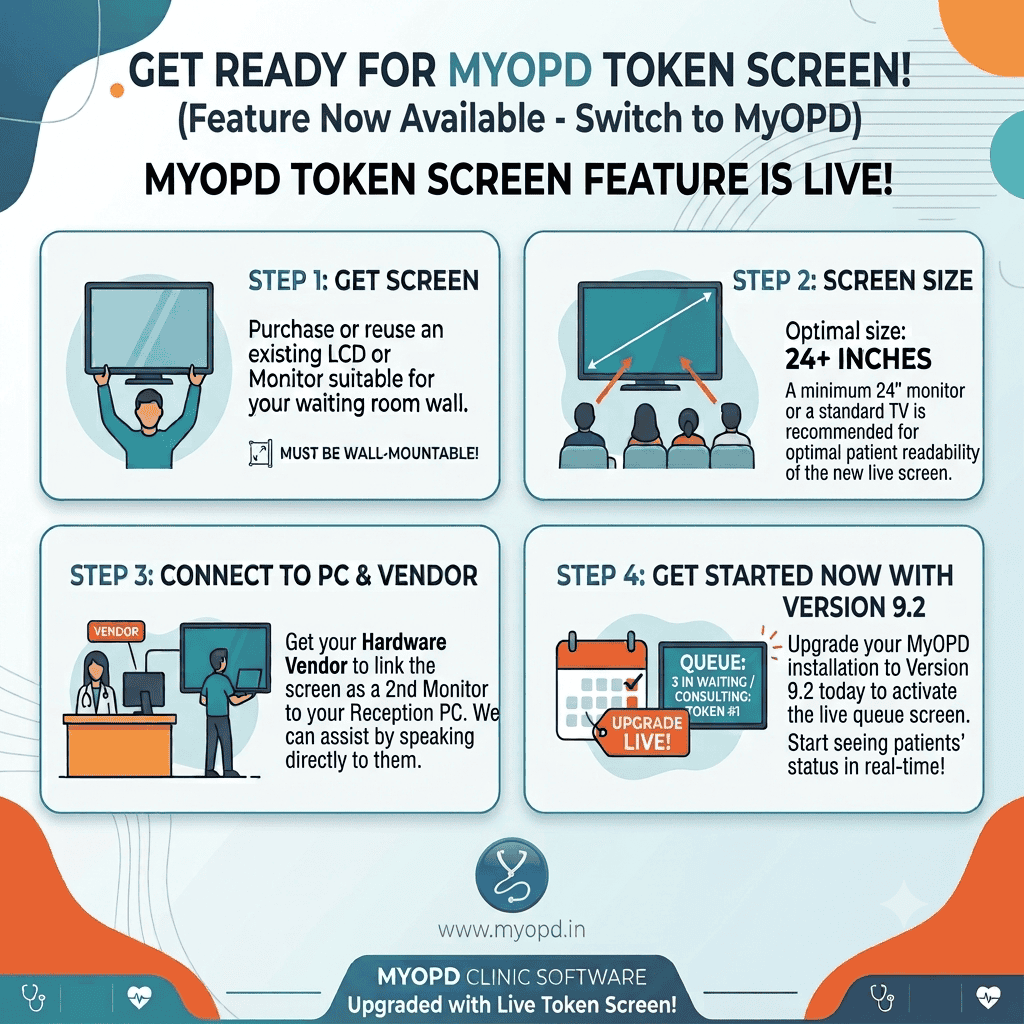
MyOPD’s Live Token Screen is here, and it’s already live for clinics running Version 9.2.


Give Your Staff Their Focus Back

Every “how much longer” is a small tax on your front desk’s attention. It breaks their flow on registration, billing, and phone calls — and it adds up to real lost productivity over a full clinic day.

A visible queue screen answers that question before it’s even asked. Patients glance up, see their token number, and sit back down. Your staff stays heads-down on the work that actually needs them.


How Patient Queue Display Software Changes the Waiting Room Experience

Instead of patients guessing their place in line, your waiting room TV shows it — automatically, in real time:

  • Current token being consulted
  • Total patients waiting
  • Live updates the second your reception team moves someone through

No manual refresh. No shouting names. No “let me check for you.” The screen does the talking, so your front desk doesn’t have to.

A visible queue does something quiet but powerful: it changes how patients experience waiting. An uncertain wait feels far longer than a known wait. A patient who can see “Token #1 is with the doctor, 3 waiting” relaxes. A patient staring at a blank room, wondering if they’ve been forgotten, doesn’t.

The result: calmer staff, calmer patients, and a clinic that feels more organized — because it is.


Why Patient Queue Display Software Matters More Than It Sounds

For a clinic or small hospital, a live queue screen translates directly into:

  • Fewer interruptions at your reception counter
  • Better patient satisfaction and word-of-mouth
  • A more professional, hospital-grade first impression — for the cost of a spare monitor

Setting Up Your Patient Queue Display: 4 Simple Steps

You don’t need new hardware, complex IT work, or a vendor visit. Here’s the whole setup:

Step 1 — Get a screen. Reuse an existing LCD/monitor or TV — anything wall-mountable works.

Step 2 — Size it right. A 24″+ display is the sweet spot for patients to read comfortably from across the room.

Step 3 — Connect it. Have your hardware vendor link the screen as a second monitor to your reception PC. If they need guidance, our team is happy to walk them through it directly.

Step 4 — Upgrade to Version 9.2. That’s what switches the live queue screen on. From that moment, your waiting room reflects real-time status automatically.


Already Using MyOPD? You’re One Upgrade Away

If you’re currently running MyOPD, this patient queue display software is included — no separate purchase, no add-on fee. Just upgrade to Version 9.2 and connect a second screen whenever you’re ready.

It’s a small hardware step that visibly changes how your clinic feels to walk into — for your staff and your patients alike.

Ready to activate it? Reach out to our team and we’ll help you get the second screen connected — often the same day.

👉 www.myopd.in


MyOPD Clinic & Hospital Management Software — built for the way Indian clinics actually run.

Patient Queue Display Software: Turn Your Waiting Room Into a Zero-Confusion Zone Read More »

Clinic Software Data Migration Made Easy — MyOPD Moves Your Entire History

Clinic software data migration with MyOPD

The Real Reason Doctors Don’t Switch Clinic Software

Clinic software data migration is the single biggest barrier doctors face when considering a switch.

The software is slow. Support is poor. Features haven’t kept up. Billing is a mess. But switching still feels impossible — because years of patient records, prescriptions, visit histories, and diagnosis data are locked inside the old system.

So doctors stay. Not because the old software is good. But because leaving feels like abandoning their patients’ entire clinical history.

We understand that. And we decided to solve it.


MyOPD Completed a Full Migration — Here Are the Numbers

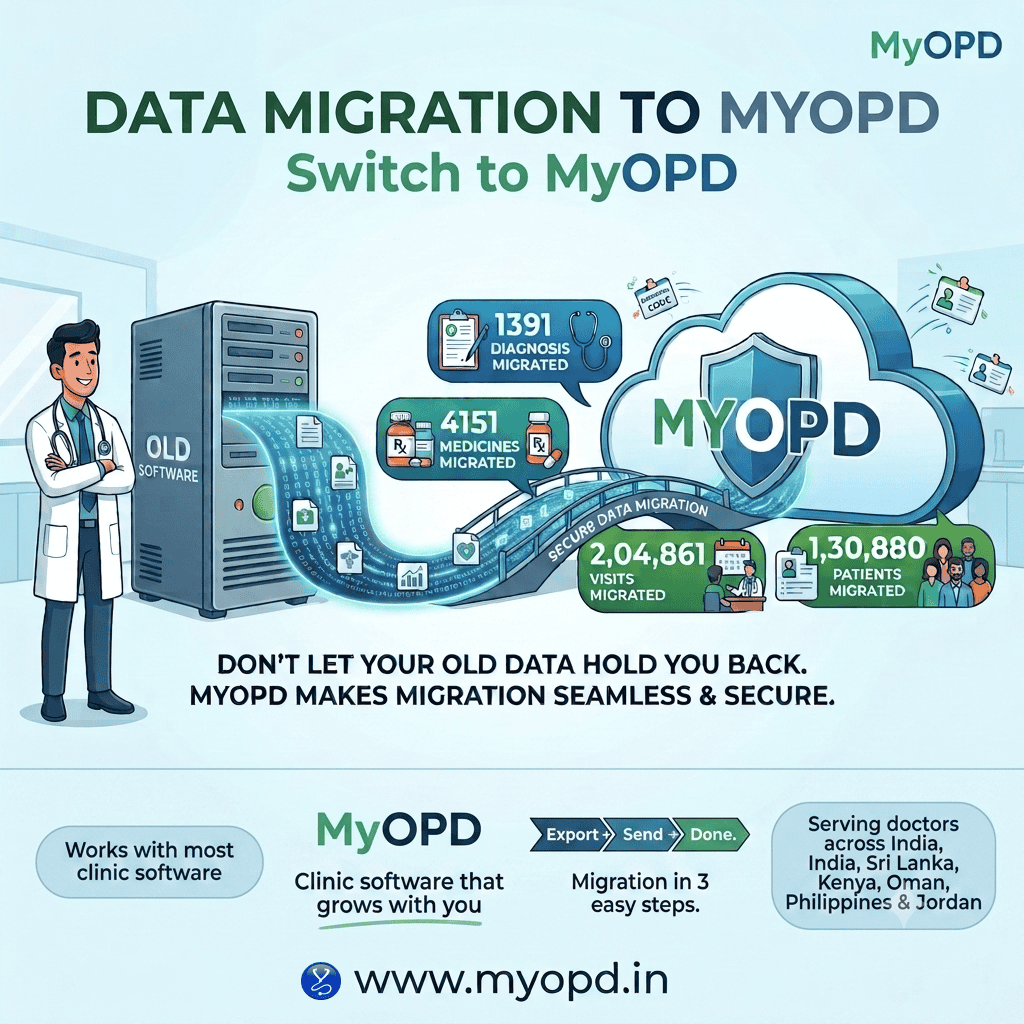
We recently completed a clinic software data migration for a practice moving from their legacy system into MyOPD. The numbers speak for themselves:

What Was Migrated Count
Patient Records 1,30,880 (130,880)
Clinical Visits 2,04,861 (204,861)
Medicines 4,151
Diagnoses 1,391

Over 1.3 lakh patients. Over 2 lakh visits. Every medicine. Every diagnosis. All moved into MyOPD — intact, structured, and ready to use from day one.

This was not a partial migration or a “we’ll try our best” situation. This was a complete, verified transfer with zero data loss.


How the Process Works

The migration process with MyOPD is designed to require minimal effort from you. You do not need to be technical. You do not need to coordinate between two software companies. You do not need to re-enter a single record by hand.

Here is all that is required from your end:

Step 1 — Export your data from your current software Most clinic software allows you to export patient and visit data as an Excel file. If you are not sure how, your current vendor’s support team can help — it is a standard feature.

Step 2 — Send the file to us Share the export file with The MyOPD Team. That’s it. Your job is done.

Step 3 — We handle the rest Our team maps your data fields, validates the records, and imports everything cleanly into your MyOPD database. We verify the counts. We check for gaps. We make sure nothing is lost.

Step 4 — You start using MyOPD with your full history intact Your patients are there. Their visits are there. Their medicines and diagnoses are there. You pick up exactly where you left off — on a better platform.


What Changes After Migration

Switching software is no longer a choice between “keep your data” and “get better software.” You can have both.

  • Search any patient and see their complete visit history from your previous system
  • Continue prescriptions without losing reference to past medications
  • Maintain diagnostic continuity — no blank slates, no re-interviewing patients
  • Your staff works with familiar records from the very first day

This migration covered more than a decade’s worth of clinical data for a busy practice. The transition was smooth. The doctor started seeing patients on MyOPD the very next day.

If you’d like to see everything MyOPD offers beyond migration — from OPD and IPD management to billing — go through our home page.


Works with Most Clinic Software

Worried your current software is not supported? We have handled migrations involving Excel and CSV exports from a range of clinic and hospital management systems used across India. If your software can export patient and visit data in this format — and in most cases it can — your migration is likely feasible.


Talk to The MyOPD Team Today

Send us a sample export file from your current software, and we’ll tell you within 24 hours whether your migration is possible.

📞 Contact The MyOPD Team Visit www.myopd.in or reach out to us directly to get started.

Your patients’ history belongs with you — not with your old software vendor.


MyOPD is a clinic and hospital management platform built for Indian doctors, trusted across India, Kenya, Oman, and Jordan. Features include OPD management, IPD and Billing.

Clinic Software Data Migration Made Easy — MyOPD Moves Your Entire History Read More »

Happy Doctors Day 2026

Happy Doctors Day 2026 Read More »

MyOPD vs HealthPlix: Which One Is Right for Your Clinic?

MyOPD vs Healthplix

If you’re researching MyOPD vs HealthPlix, you’re probably in one of two situations.

Maybe you’re already using HealthPlix and something isn’t quite working — the internet drops mid-OPD, the annual renewal feels less like a service and more like a deadline, or you’ve started wondering whether your patient data is really yours to keep. You’re not unhappy enough to have decided yet, but you’re asking questions.

Or maybe you’re evaluating clinic software for the first time — and both MyOPD and HealthPlix have come up as options. You want to make the right call before you commit to something you’ll use every single day.

Either way, this article is for you.


7 points Every Doctor Should Ask Their Clinic Software Provider

1. What happens to my clinic software when the internet goes down?

This is the question that matters most for the majority of Indian clinics — and it’s one that cloud-based software providers rarely answer clearly upfront.

With any fully cloud-based EMR, the answer is simple: your software stops working. No internet means no login, no patient lookup, no prescription generation. In a busy OPD, even a 15-minute outage can disrupt your entire session.

Ask yourself: How many times in the last month did your internet slow down or drop during working hours?

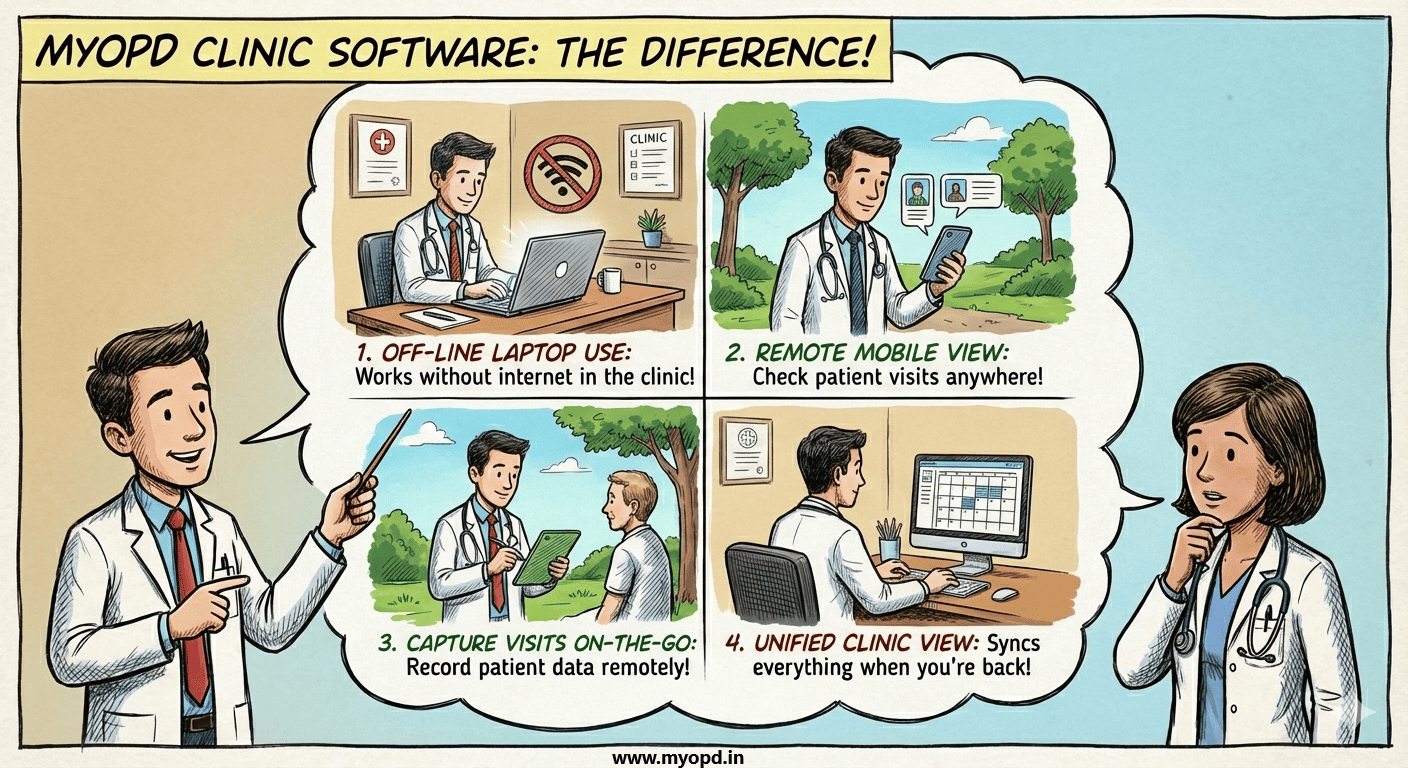
MyOPD is installed directly on your Windows laptop. Your entire patient database, prescription templates, medicine list, and billing data lives locally on your machine. When the internet goes down — or was never available to begin with — your OPD continues without interruption. In fact, because everything runs locally, MyOPD is often faster than cloud-based alternatives even when the internet is working fine. There’s no server latency, no loading screens, no waiting for data to sync before you can open a patient record.

SMS and WhatsApp appointment reminders still work too. These run in the background through MyOPD’s cloud servers — so even with limited internet access once a day or every couple of days, your reminders go out automatically without any action from you.

If internet is not your concern, a fully cloud-based EMR is an option.


2. What happens to my software and my data if I stop paying?

This is the question most doctors never think to ask — until it’s too late.

With cloud-based clinic software, your login is tied to your subscription. The moment you stop paying, your access is revoked. You may be offered a data export — typically a spreadsheet download — but that is not the same as having your software. An Excel file cannot show you a patient’s prescription history the way your software can. It cannot let you search by diagnosis, filter by date, or print a formatted record. It’s a raw data dump, not a working clinic system.

MyOPD offers Lifetime plans. Under a Lifetime plan, you own your software permanently. Even if you never renew your AMC, your installed MyOPD continues to work — forever. You can open it tomorrow, or five years from now, and every patient record is right there: searchable, viewable, and printable, exactly as it was the day you last used it.

This matters enormously for a doctor who has spent years building a patient database. Your clinical records are a professional and medico-legal asset. You should never be in a position where a vendor’s business decision — a price increase, a shutdown, a merger — puts that asset at risk.

With MyOPD, it never is.

Pricing transparency matters too. MyOPD’s plans are published openly on our website — what you see is what you pay. No mid-year surprises, no sudden revision emails, no penalty for growing your practice. When you choose a plan, you know exactly what you’re committing to.


3. Is my data safe if my computer crashes?

Going offline doesn’t mean going unprotected. MyOPD automatically backs up your patient data to our secure cloud servers periodically — so even if your hard disk fails or your laptop needs to be formatted, your data is recoverable. You get the reliability of local software and the safety of cloud backup — without being dependent on the cloud to work every day.


4. How often does the software actually improve?

Software that doesn’t update is software that stagnates. But there’s a flip side too — cloud software that updates constantly can change workflows without warning, remove features you rely on, or introduce bugs mid-OPD that you can’t roll back.

MyOPD releases a new update every three months — a predictable, stable cadence. Each release is tested before it reaches you, and you can see exactly what has changed. You’re always moving forward, but never surprised.

👉 View MyOPD’s complete update history


5. What happens to my existing patient data if I start with MyOPD?

For doctors switching from another platform, this is often the single biggest concern. Years of patient registrations — the thought of starting from scratch is enough to keep anyone on a platform they’re no longer happy with. And for doctors choosing software for the first time, it’s worth knowing how easy it will be to bring data in if you ever migrate from paper registers or another system later.

MyOPD has successfully migrated doctors with 20,000+ patient records from HealthPlix into MyOPD.

When you migrate from HealthPlix, your existing patient registration details — names, ages, phone numbers, addresses, patient IDs — come with you. When a patient walks into your clinic on Day 1 with MyOPD, they’re already in your system. You don’t re-register them. You don’t ask them to repeat their details.

MyOPD can also import your frequently used medicine list, so your prescriptions feel familiar from day one. Simply share the file with our team and we’ll take care of the rest.

It’s important to set the right expectation here: MyOPD currently imports patient registration data. Past prescription history and treatment records from HealthPlix are not imported. For most doctors, this is a practical non-issue. You can plan ahead and create a summary visit in MyOPD while your HealthPlix account is active. For newer consultations, start using MyOPD. However, if having the full clinical history of every patient inside MyOPD from day one is a hard requirement for you, this is worth factoring into your decision.

For Doctors starting fresh on MyOPD — whether from paper or from another system — our team will guide you through getting set up correctly from the start. You don’t need to manage data imports or technical configurations yourself.


6. Does adding another doctor or staff member cost extra?

Many clinic software providers charge per doctor login or per staff account — meaning every time your practice grows, your software bill grows with it. If you bring on an associate doctor, a second compounder, or a receptionist, you’re looking at an additional seat charge. For a growing clinic, this adds up quickly and creates a disincentive to give your team proper access.

MyOPD’s flexible plans let you add doctor and staff accounts without any extra charge. You have full control over who gets access — whether that’s an associate doctor, a nurse, or front desk staff — without worrying about per-user costs. Your software grows with your clinic, not against it.


7. How important is support and how do I get it?

You may want to read this first: Do I Really Need Product Support?

Support is one of those things that feels invisible until you need it urgently. Before choosing any clinic software, ask yourself:

  1. Have I ever received good support from the vendor I’m working with?
  2. Do they address my concerns while I’m using the application?
  3. Do they take in suggestions and build those into the product to improve it over time?

MyOPD support is with you when you need help with a configuration issue, a billing question, or a technical problem — accessible and affordable, without being locked behind an expensive tier.

Don’t just take our word for it. Many doctors who use MyOPD have shared their experience with support on our Google reviews — see what they have to say here.


Who Should Choose MyOPD

MyOPD is the right choice if any of the following describes you — whether you’re choosing clinic software for the first time or considering a switch:

  • Your clinic is in an area where internet is inconsistent, slow, or unavailable during OPD hours
  • You want permanent ownership of your software and your data — not a subscription that holds your records hostage
  • You see high patient volumes and need software that responds instantly, without lag
  • You want the flexibility of a Lifetime plan and freedom from mandatory annual renewals
  • You’re adding associate doctors or staff and don’t want per-user charges eating into your margins
  • You’re switching from HealthPlix and want your patient registration data to come with you
  • You want predictable, tested updates on a known schedule — not surprise changes to your workflow

When MyOPD May Not Be the Right Fit

We believe in helping you make the right decision — even if that means being upfront about where MyOPD has limitations.

You use a Mac. MyOPD is a Windows-native application and does not run natively on macOS. If you use a Mac, you can still run MyOPD using Parallels Desktop for Mac, which lets you run Windows on your Mac. However, this adds cost and setup complexity. If a Mac-native solution is important to you, factor this in.

You need a single login across multiple clinics. If you operate at two or more clinic locations and need the same doctors seeing the same patient records under the same login simultaneously, MyOPD is currently not designed for this use case. MyOPD is best suited for a single primary clinic installation.

You need complete clinical history imported from HealthPlix. As noted above, MyOPD imports patient registration data — not past prescriptions, medicines, or treatment history. If your workflow depends heavily on reviewing historical prescriptions from within the software from day one, this is worth considering.

For everything else — reliability, data ownership, speed, offline operation, and long-term value — MyOPD is built for the independent Indian doctor.


Ready to Get Started?

Whether you’re choosing clinic software for the first time or making the move from HealthPlix, getting started with MyOPD is straightforward — and our team is with you every step of the way.

Switching from HealthPlix? Your patient registration data comes with you. Starting fresh? We’ll help you get set up and running from day one.

Download Free Trial | View Pricing & Lifetime Plans | Contact Us


All competitor information in this article is based on publicly available information and interactions with prospects who have asked comparative questions between the various products, as of May 2026. This article does not claim to cover the entire list of features available for either software. Readers are encouraged to speak with the respective companies to get a complete overview of their offerings. The HealthPlix trademark belongs to its respective owner. MyOPD makes no claim of partnership or endorsement by HealthPlix.

Images in this article were generated using AI.

MyOPD vs HealthPlix: Which One Is Right for Your Clinic? Read More »

How to Set Up a Paperless Clinic in India: A Step-by-Step Guide for Doctors

Every doctor who has run a busy OPD knows the feeling. A patient walks in and asks about a visit from two years ago. Your assistant flips through register after register. Five minutes pass. The prescription pad from that visit is gone. The diagnosis — gone with it.
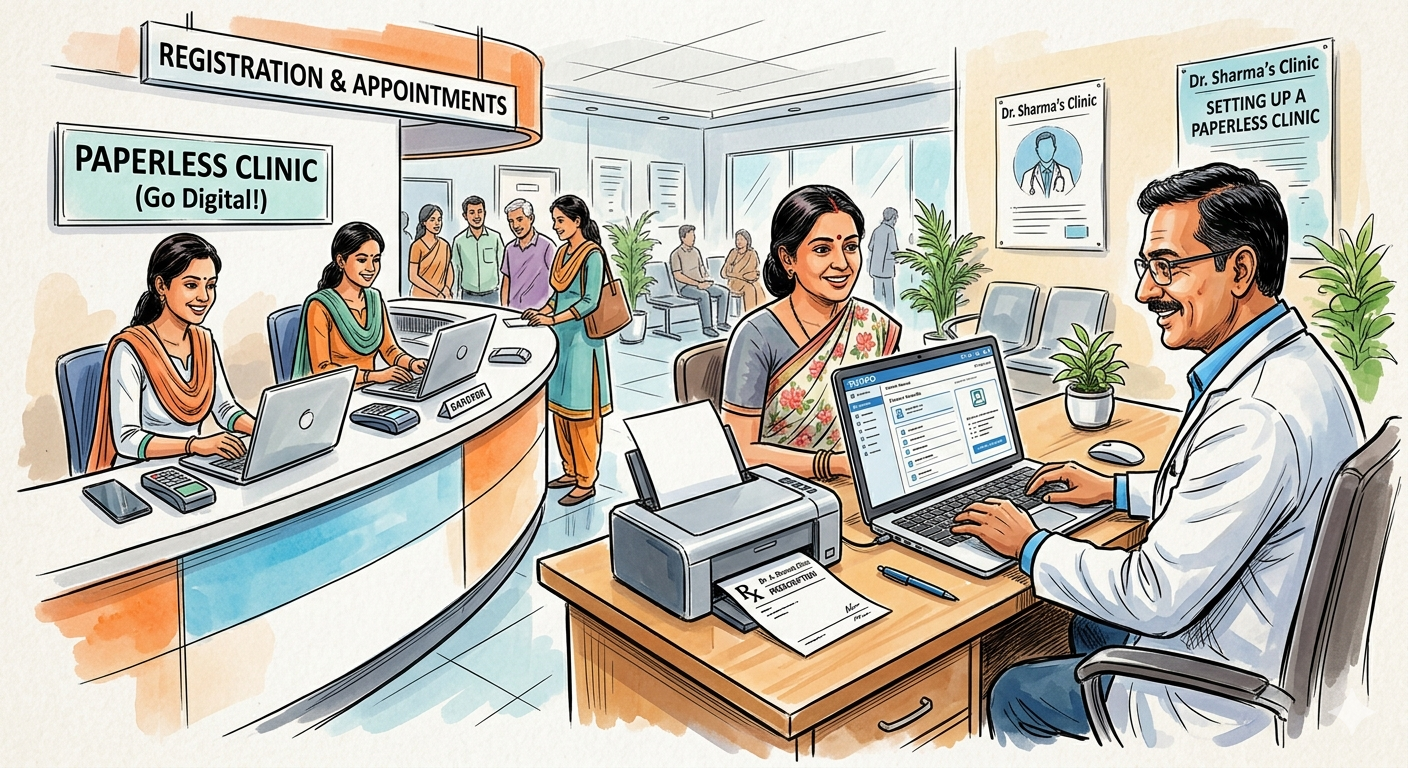
Paperless clinic setup in India

Paper-based clinics aren’t just inefficient. They are increasingly a liability: for your time, for your patients, and for the long-term health of your practice.

The good news is that going paperless is no longer complicated or expensive. Thousands of doctors across India have already made the switch — in cities, in towns, and in areas where internet connectivity is patchy at best. This guide walks you through exactly how to do it, step by step.

What Does “Paperless Clinic” Actually Mean?

Going paperless doesn’t mean you’ll never print anything again. It means your clinic’s core operations — patient registration, prescriptions, medical history, appointments, billing — are managed digitally rather than on paper registers and prescription pads.

In practice, a paperless clinic looks like this:

  • Patients are registered once in a digital system. Their name, age, phone number, and history are available instantly on every future visit.
  • Prescriptions are generated on a computer and printed (or sent digitally via WhatsApp) — no handwriting, no illegibility.
  • Appointment reminders go out automatically via SMS or WhatsApp — no manual calling.
  • Billing is done through the software — no handwritten receipts or manual fee registers.
  • Your patient data is backed up automatically — no risk of losing years of records in a flood, fire, or hard drive crash.

You still interact with patients the same way. You still print prescriptions if needed. The difference is that everything behind the scenes runs on software instead of paper.

Step 1: Decide What You Want to Digitize First

Most doctors make the mistake of trying to go fully paperless overnight. A better approach is to start with the two highest-impact areas and expand from there.

Start with prescriptions and patient registration. These two alone will give you 80% of the benefit of going paperless. When every patient is registered digitally and every prescription is generated by software, your OPD immediately becomes faster, more organised, and more professional.

Once you’re comfortable with these, add:

  • Appointment scheduling and reminders
  • Billing and receipts
  • Lab reports and documents (scan and attach)
  • Follow-up tracking

There’s no rush to do everything at once. Most clinics are fully paperless within two to three months of starting.

Step 2: Choose the Right Clinic Software

This is the most important decision. The software you choose will determine whether your paperless transition is smooth or frustrating. Here’s what to look for in the context of Indian clinics:

Works without internet during your OPD. This is non-negotiable for most Indian clinics. Internet connections go down. Power fluctuates. Your software must keep working regardless. Look for software that is installed on your computer and runs locally — not cloud-only software that stops when your internet does.

Fast prescription generation. You should be able to generate a complete prescription — diagnosis, medicines, dosage, instructions — in under a minute. If the software is slow or requires too many clicks, your OPD will slow down, not speed up.

Multilingual prescription printing. Many of your patients — especially elderly ones — cannot read English. Your software should be able to print prescriptions in your regional language so patients can follow instructions correctly.

Automatic data backup. Your patient database is one of your most valuable professional assets. Choose software that backs up your data to the cloud automatically, without you having to remember to do it.

Appointment reminders. The software should send automatic SMS or WhatsApp reminders to patients — reducing no-shows without any manual effort from your staff.

MyOPD is the trusted paperless clinic India solution for thousands of independent doctors. It runs installed on your Windows laptop — so it works completely without internet during your OPD — while automatically backing up your data to the cloud once a day. Prescriptions can be printed in 13 Indian languages, and appointment reminders go out automatically. It’s the approach that has made MyOPD the trusted choice for thousands of independent clinics across India.

Step 3: Set Up Your Hardware

Going paperless requires minimal hardware investment. For most clinics, you’ll need:

A Windows laptop or desktop PC. This will be the main workstation where you run your clinic software. Any mid-range Windows laptop (Intel Core i3 or above, 8GB RAM, Windows 10 or 11) is sufficient. If you already have a working Windows laptop, you may not need to buy anything new.

A printer. You’ll still print prescriptions, at least initially. A basic laser printer (black and white) is ideal — fast, low running cost, and reliable. If you already have one, you’re all set.

A receipt or thermal printer (optional). If you want to give patients printed billing receipts, a small thermal printer is inexpensive and fast. Many clinics skip this and simply show the bill on screen or send it via WhatsApp.

A scanner or smartphone (optional). For attaching old paper records or lab reports to a patient’s digital file, a basic flatbed scanner works well. Alternatively, most smartphones have good enough cameras to scan documents using a free app.

That’s it. You do not need a server, a dedicated IT team, or any special networking equipment to run a paperless clinic.

Step 4: Migrate Your Existing Patient Data

This is the step most doctors worry about — and it’s far simpler than it sounds.

You do not need to enter all your old records before you start. This is the most common misconception that delays doctors from making the switch. Here’s the practical approach:

Start fresh from the day you begin using the software. Register every new patient digitally from that day forward. When an existing patient comes in for a visit, register them at that point. Within three to six months, your most active patients will all be in the system.

For critical long-term patients — those with chronic conditions like diabetes, hypertension, or thyroid disorders — you can take 10–15 minutes per patient to enter their key history when they next visit. Your assistant can do this while the patient waits.

Old paper registers don’t need to be destroyed. Keep them in storage. But you’ll find you reach for them less and less over time.

Step 5: Train Your Staff

A paperless clinic runs on your clinic assistant as much as it runs on you. Your assistant will handle patient registration, appointment scheduling, and billing — and their comfort with the software is critical.

Plan for a one-week learning curve. Most assistants adapt quickly, especially with modern clinic software that is designed to be simple. In the first week, things may feel slower than paper. By the second week, registration will be faster than your old register. By the end of the month, your assistant will wonder how they ever managed without it.

Tips for a smooth staff transition:

Keep your old register running in parallel for the first two weeks. This gives your assistant a fallback and builds confidence. Once they’re comfortable with the software, retire the register.

Ask your software provider for a training session. Most reputable clinic software companies — including MyOPD — offer onboarding support to help your staff get started correctly.

Designate one person as responsible for data quality. Consistent patient registration (correct phone numbers, correct spelling of names) will save you significant time in the future.

Step 6: Handle Prescriptions and Billing Digitally

Once your software is set up and your staff is trained, prescriptions and billing become the natural next step.

Prescriptions: Most clinic software lets you build a personal template over time — your commonly prescribed medicines, your preferred formats, your clinic letterhead. Within a few weeks of daily use, generating a prescription becomes a matter of selecting the right medicines from your personal list rather than writing each one from scratch. This alone saves 2–3 minutes per patient in a busy OPD.

Billing: Digital billing through your software means every transaction is recorded automatically. At the end of the month, your total collections, patient count, and outstanding dues are available as a report — without manually tallying a register.

Sending prescriptions via WhatsApp: Many clinic software solutions, including MyOPD, let you send a prescription directly to the patient’s WhatsApp. This is particularly popular with patients who don’t want to carry a physical prescription — and it means the patient always has a copy, reducing calls to your clinic asking for a repeat prescription.

Step 7: Set Up Appointment Reminders

Missed appointments are one of the biggest sources of revenue loss and scheduling headache for any clinic. Once your clinic software is managing appointments, automated reminders are a game-changer.

Good clinic software sends a reminder SMS or WhatsApp message automatically — one day before the appointment, or at any interval you choose. You set it up once; the software handles it forever.

In practice, clinics that use automated reminders report significantly fewer no-shows and a more predictable daily schedule.

Step 8: Go Fully Paperless — at Your Own Pace

By this point, your clinic is already functionally paperless. Most of the key operations — registration, prescriptions, billing, appointments — are running digitally. The remaining step is simply to extend this to the last few areas where paper may still linger.

Lab reports: Scan them and attach them to the patient’s file in your software. Or, if your lab provides digital reports, they can be stored directly.

Referral letters: Generate these from your software using a template rather than handwriting them.

Patient consent forms: If you collect signed consent forms (for procedures, surgeries, etc.), keep the originals in a physical file but note the date and procedure in your software record.

Old paper registers: Once you’ve been running digitally for six months, your old registers can be archived in storage. Keep them for three to five years as a precaution, then safely discard.

Common Concerns — and Honest Answers

“What if my computer crashes?”

This is the most common concern, and it’s a valid one. The answer is: choose software that backs up your data to the cloud automatically. With MyOPD, your data is backed up every day. If your laptop dies tomorrow, your patient records are safe and can be restored on a new machine.

“What if the power goes out?”

Keep your laptop charged during OPD so you have battery backup. A small UPS (Uninterruptible Power Supply) for your printer costs under ₹2,000 and keeps your setup running through short outages.

“My patients are elderly and prefer paper prescriptions.”

Going paperless doesn’t mean stopping paper prescriptions. You print them exactly as before — the difference is that they’re generated by software and look professional, with your clinic letterhead, clear medicine names, and instructions in the patient’s language. Most patients actually prefer this to handwritten prescriptions.

“I’m not tech-savvy.”

Modern clinic software is designed for doctors, not engineers. If you can use WhatsApp, you can use clinic software. And most providers — including MyOPD — offer hands-on support during the initial setup period.

“It will slow down my OPD.”

It will slow things down for the first week. By the second week, it will be the same speed. By the end of the first month, your OPD will be noticeably faster — because patient lookup is instant, prescription generation is faster than handwriting, and your assistant is no longer searching through registers.

The Real Cost of Staying on Paper

Before we close, it’s worth reflecting on what paper-based clinic management actually costs — costs that are invisible because they’re built into your daily routine.

Every time you or your assistant spends five minutes looking for an old patient record, that’s five minutes of OPD time lost. Every prescription that gets lost or misread is a potential patient dissatisfaction or medical error. Every appointment that gets missed because no one called to remind the patient is revenue gone. Every year-end when you try to calculate your total collections from a handwritten register is hours of manual work.

These costs are real. They’re just spread thin enough across each day that they feel like background noise rather than a problem to solve.

Going paperless solves them — permanently.

Ready to Make the Switch?

MyOPD offers a free trial so you can experience a paperless clinic before committing. It’s installed on your Windows laptop, works without internet during your OPD, and backs up your data automatically every day.

Join thousands of Indian doctors who have already made the switch — and wonder how they ever managed without it.

Download Free Trial | View Pricing | Contact Us
How to Set Up a Paperless Clinic in India: A Step-by-Step Guide for Doctors Read More »

How to Select Clinic Software for Your Practice

Every doctor reaches a point where paper registers, prescription pads, and manual appointment books just don’t keep up. You miss follow-ups. Prescriptions get misplaced. Billing takes too long. That’s when clinic software becomes not just helpful — but essential.

But with so many options available, how do you choose? This guide breaks down the three main types of clinic software — Online, Offline, and Hybrid — and shows you clearly why thousands of Indian doctors have made MyOPD their trusted practice management solution.

The First Question to Ask: Internet or No Internet?

Before anything else, think about your clinic’s internet reliability. This single factor will determine which type of software actually works for you — not just on paper, but in your day-to-day practice.

Option 1: Online Clinic Software (Cloud-Based)

Cloud-based software runs entirely on the internet. Your data lives on a vendor’s server, and you access it through a browser or app.

Sounds convenient — but here’s the reality for most Indian clinics:

  • If your internet is slow, your software is slow. If internet is down, you cannot work.
  • You pay a recurring subscription per year — every year, without fail.
  • Stop paying? Many vendors restrict or block access to your own patient data.
  • You are dependent on the vendor’s servers — if they go down, your clinic stops.
  • You also bear internet charges on top of the subscription fee.

Online software makes sense for large multi-location hospital chains with dedicated IT teams and guaranteed high-speed internet. For most independent doctors and small clinics in India, it creates more problems than it solves.

Option 2: Offline Clinic Software (Desktop-Based)

Offline software is installed directly on your computer. No internet needed — ever.

It sounds safe, but there are real risks:

  • Your data lives only on your computer. If your hard drive fails or your laptop is stolen, your entire patient database could be gone.
  • USB and external drive backups can also fail — and most doctors forget to back up regularly.
  • SMS appointment reminders require purchasing and setting up a separate device.
  • No access from your phone or from outside the clinic.

Offline software is a step up from paper — but it leaves your valuable patient data exposed to hardware failure, with no easy recovery path.

Option 3: Hybrid Clinic Software — The MyOPD Advantage

What if you didn’t have to choose between the speed of offline and the safety of cloud? That’s exactly what MyOPD delivers with its Hybrid approach — and it’s why MyOPD has become the preferred clinic software for doctors across India.

How to select the best clinic software for Indian doctors

Here is how MyOPD works differently:

  • Installed on your Windows laptop — runs fast locally, just like offline software. No lag, no internet dependency for daily use.
  • Works completely without internet during your OPD. Connect once a day — from home or hospital — and MyOPD automatically syncs and backs up your data to the cloud. Your data is always safe.
  • MyOPD All In One App available on Android and iOS lets you check patient details, appointment history, and records on your phone — even without internet.
  • Appointment reminders and follow-ups are sent automatically via SMS or WhatsApp from MyOPD’s cloud server. No extra device needed.
  • Stop the AMC? Your installed software keeps working and all your data stays with you. No one holds your data hostage.
  • Professional prescriptions printed in 13 languages: English, Hindi, Marathi, Gujarati, Kannada, Tamil, Telugu, Punjabi, Bengali, Odia, Malayalam, Urdu, and Arabic — clear enough for any patient to understand.

Why Thousands of Indian Doctors Choose MyOPD

MyOPD is built specifically for the realities of Indian medical practice — not adapted from a foreign product:

  • Designed for high patient volumes — ideal for Physicians, Pediatricians, Gynecologists, and ENT specialists who see 50–100+ patients a day.
  • Works reliably even in cities and towns with inconsistent internet.
  • No risk of losing your patient data — ever. Daily automatic cloud backup protects you.
  • Affordable annual maintenance — and you’re never locked out if you stop.
  • Trusted by doctors across India for years, with a track record of stability and continuous improvement.
  • Local language support means your patients — including elderly ones — can read and follow prescriptions without confusion.

Online vs Offline vs Hybrid (MyOPD) — At a Glance

[TIP: In WordPress, replace this table by inserting a Table block or use TablePress for better mobile display]

FeatureOnline (Cloud)Offline (Desktop)Hybrid (MyOPD ✓)
Internet RequiredAlways neededNever neededOptional — sync once/day
SpeedDepends on internetFast (local)Fast (installed locally)
Works During Outage❌ No✅ Yes✅ Yes
Data SafetyCloud (vendor holds it)Risk if PC crashesDaily auto cloud backup
Data OwnershipVendor controlsYou own itYou own it — always
Multi-device AccessYes (any device)NoLaptop + Android app
SMS RemindersAuto from cloudNeeds extra deviceAuto from cloud
Multilingual PrintVaries by vendorVaries by vendor13 Indian languages ✓
Stop Paying?May lose accessSoftware still worksSoftware still works
Best ForMulti-location clinicsLow-internet areasMost Indian clinics ✓

Also Consider: Which MyOPD Product Should You Use?

Beyond the software type, your device matters. MyOPD runs on Windows laptops and PCs, with an Android app for mobile access. If you’re deciding between devices for your clinic, our detailed product selection guide will help you choose the right hardware alongside your software.

Ready to Run a Smarter Clinic?

You’ve worked hard to build your practice. Your clinic software should protect it, not create new problems. MyOPD gives you the speed of offline software, the safety of cloud backup, and the convenience of mobile access — at a price that makes sense for Indian doctors.

Join thousands of doctors who have already made the switch.

Have questions before you decide? View our sample prescriptions in multiple languages, or contact us — we’re happy to walk you through the software before you commit.

How to Select Clinic Software for Your Practice Read More »

Can Clinic Management Software Help You See More Patients?

Know the main reason why many Doctors are reluctant to use Clinic Management Software?

If you run a busy clinic, you already know the bottleneck: you.

Patients are waiting. Your assistant has done the vitals. But every prescription, every diagnosis entry, every follow-up note still has to go through your hands — and your hands are already full. By the time you finish entering data for one patient, three more are sitting outside getting restless.

There’s a better way. And clinics are already using it.

The “Doctor + Assistant Doctor” Workflow

Visual representation: A collaborative Doctor + Assistant workflow (AI-generated illustration).

MyOPD’s clinic management software supports a two-tier consultation model that mirrors how the best hospitals in the world operate — and now brings that same efficiency to your OPD.

Here’s how it works:

Step 1 — The Assistant Doctor sees the patient first. Your junior doctor or assistant handles the initial consultation. They record the patient’s chief complaints, take the history, note vitals, and enter all the preliminary findings directly into MyOPD. Everything is documented, structured, and ready.

Step 2 — You step in as the decision-maker. By the time you sit across from the patient, the groundwork is done. You review the assistant’s findings on-screen, apply your clinical judgment, confirm or adjust the diagnosis, and either write the prescription or review the one suggested by your assistant — with a single click.

No repetitive data entry. No starting from scratch. Just the high-value clinical decision that only you can make.

Why This Changes Everything for Senior Doctors

Whether you’re already using MyOPD or exploring ways to modernise your clinic, one challenge remains universal: in a busy OPD, a senior doctor’s time is your most valuable — and most stretched — resource.

As patient volumes grow, more and more of that time goes toward data entry alongside clinical decision-making. The Doctor + Assistant Doctor setup doesn’t change how you practice — it simply ensures that your time and expertise are focused exactly where they matter most: diagnosing, deciding, and caring for your patients.

With the Doctor + Assistant Doctor setup in MyOPD:

  • You spend less time typing, more time thinking. The cognitive work of diagnosis and treatment planning is yours. The administrative load is handled.
  • Your assistant gets meaningful clinical exposure. Junior doctors grow faster when they’re actively participating in consultations, not just filing papers.
  • Patients get faster, better care. Shorter waiting times. A more focused senior doctor. A smoother overall experience.

Built for Real Clinic Workflows

MyOPD’s interface is designed so that the handoff between your assistant doctor and you is seamless. The assistant’s notes appear clearly on your screen. You can accept findings, add to them, or override them — all within the same patient record, in real time.

There’s no duplication of effort. No switching between systems. No printing and re-entering. One software, one patient file, two doctors working in sync.

This is particularly powerful for:

  • Specialist clinics where detailed history-taking (e.g., dermatology, orthopaedics, gynaecology) can be time-consuming but largely protocol-driven — ideal for an assistant to handle.
  • High-volume General Practice where the sheer number of patients makes single-doctor data entry a genuine operational bottleneck.
  • Multi-doctor setups where roles and responsibilities need to be clearly tracked and documented.

The Bigger Picture: Digitising Your Clinic the Right Way

One of the biggest barriers to digitisation in clinics is this: senior doctors, especially those who have practised for decades, find it difficult to adapt to typing-heavy software interfaces.

The Doctor + Assistant Doctor model in MyOPD solves this elegantly. The senior doctor’s interaction with the software is minimal and focused — reviewing, confirming, and prescribing. The heavy lifting of data entry is handled by the assistant. This makes adoption dramatically easier, and the transition to a fully digital clinic far less disruptive.

Your clinic becomes paperless. Your records become searchable. Your prescriptions become legible. And you didn’t have to change how you practice — just how your team supports you.

Ready to Transform How Your Clinic Operates?

MyOPD is trusted by thousands of Doctors to manage their clinics efficiently, accurately, and on their own terms.

Setting up the Doctor + Assistant Doctor workflow takes minutes. The impact lasts every single day.

Visit www.myopd.in to get started, or contact our team for a free demo tailored to your clinic.

MyOPD — Clinic & Hospital Management Software, built for doctors who put their patients first.

Can Clinic Management Software Help You See More Patients? Read More »

How to accept UPI Payments using MyOPD Clinic Software?

Managing a busy OPD is about more than clinical excellence; it’s about operational efficiency. One of the biggest bottlenecks in Indian clinics today is the payment desk.

The “Manual UPI” Headache

Your staff likely faces these daily frustrations while handling UPI Payments in the Clinic:

  • Manual Entry: Staff must verbally tell the patient the amount.
  • User Error: Patients might input the wrong amount into their UPI app.
  • Verification Stress: Staff must hover over the patient’s phone to confirm the “Payment Successful” screen and the correct amount.

The Problem with Traditional POS Machines

To solve this, many clinics rent POS (Point of Sale) devices from banks like SBI POS Machine, ICICI POS Machine or get such devices from RazorPay, Phone Pe or Pay TM. While these machines confirm payments, they come with “hidden” burdens:

  1. Fixed Costs: Monthly or yearly rental fees just to keep the machine.
  2. Transaction Commissions: A percentage of your hard-earned revenue often goes to the provider.
  3. Counter Clutter: Another device to charge, update, and manage.

How MyOPD Saves Money and Time for Your Practice

MyOPD Software offers a bridge between manual UPI and expensive POS machines. It turns your existing computer into a payment terminal.

How it works:

  1. Automatic QR Generation: MyOPD generates a dynamic QR code on your screen based on the exact billing amount entered by your staff.
  2. Eliminate Errors: The patient scans the code, and the exact amount is pre-filled. They can’t underpay by mistake.
  3. Direct-to-Bank: The money goes straight to your existing bank account via your standard UPI ID.
  4. Zero Extra Fees: No monthly rentals for extra hardware and no middleman commissions on UPI transactions.

See UPI with MyOPD Clinic Software in action below

Ready to Streamline Your Clinic?

Stop paying for hardware you don’t need. Experience a faster, more professional billing process that keeps your overheads low.

Download the free trial of MyOPD Clinic and Hospital Software today: 👉 www.myopd.in


How to accept UPI Payments using MyOPD Clinic Software? Read More »

3 Reasons Doctors are Switching to MyOPD Clinic Software

In today’s digital age, your practice is only as strong as the technology supporting it. We’ve noticed a significant trend: more healthcare professionals are switching to MyOPD Clinic Software and Hospital Software to escape the frustration of outdated, “dead” systems that no longer receive updates. If you are looking for a reliable, evolving solution that grows with your clinic or hospital, discover the three core reasons why MyOPD is the trusted choice for the future of medicine.

📺 Watch: Why MyOPD is the Reliable Choice for 2026

MyOPD Clinic Software 3 Reason to choose

1. Continuous Innovation: Updates Every 3 Months

The biggest mistake a software provider can make is standing still. Tech moves fast, and “dead software” is a liability for a busy clinic.

MyOPD releases regular software updates every 3 months. This ensures that:

  • Your system remains fast and optimized for the latest hardware.
  • New features are added regularly to simplify your daily workflow.
  • Security patches and bug fixes are handled proactively.

By choosing MyOPD, you aren’t just buying a product; you are investing in a platform that prioritizes continuous improvement.

2. Clinic Software Built on Real-World Doctor Feedback

We don’t build features in a vacuum. The most successful Hospital Software is designed by those who actually use it in the trenches.

Every update we release is heavily influenced by feedback from our community of practicing doctors. We listen to the daily challenges healthcare providers face—from prescription printing to complex billing—and we build solutions that address them directly. When you use MyOPD, you are using a tool sharpened by the collective experience of thousands of your peers.

3. Future-Proof Compatibility (No More “PC Stress”)

One of the most common technical headaches for doctors is upgrading a computer or moving to a new version of Windows.

With MyOPD, that stress is gone. Our software is built to be future-proof:

  • Windows Ready: Fully compatible with Windows 10, Windows 11, and future iterations.
  • Seamless Hardware Migration: Changing your PC? Your software and data move with you without complex re-installations.
  • One-Click Updates: You don’t need an IT degree. Staying current is as easy as clicking a single button within the app.

Final Verdict: Is it time to switch?

If you are tired of software that feels like it’s stuck in the past, it’s time to move to a platform that looks toward the future. Watch the full explanation here:

Mobility with MyOPD ZIP

For doctors on the move, MyOPD ZIP offers the ultimate clinic management experience on Android. Just like our desktop version, it is part of our commitment to continuous improvement, receiving regular updates to keep your mobile practice secure and efficient.

Conclusion: Secure Your Practice Today

Your medical practice deserves software that is as dedicated to excellence as you are. Don’t settle for static, outdated systems. Switch to a MyOPD Clinic and Hospital Software that evolves, stays current, and puts the doctor first.

Ready to see the difference? Download the free trial by visiting www.myopd.in on contact us using the WhatsApp icon on this page.

3 Reasons Doctors are Switching to MyOPD Clinic Software Read More »

Unveiling the Best of 2025: Top 5 New Features in MyOPD Clinic and Hospital Software

At MyOPD, we believe healthcare software should never stand still. It needs to evolve just as fast as your practice does.

That’s why we commit to quarterly releases for our Clinic and Hospital Software. Throughout 2025, we pushed out numerous updates. Many of these features came directly from you—our users—suggesting ways to make daily operations smoother. Others were innovations our team developed to keep your practice ahead of the curve.

But we know you are busy. Digging through a year’s worth of release notes to find the “game-changers” takes time you might not have. So, we did the heavy lifting for you. We’ve reviewed every update from the past year and distilled them down into one concise video: The Top 5 Features of Year 2025.

Watch Now: Top 5 Features of Year 2025

New to MyOPD? Experience the Difference Today!

If you aren’t using MyOPD yet, you are missing out on the most efficient way to manage your clinic or hospital. Why just watch the features when you can use them?

Try MyOPD for Free: See how these features fit into your workflow with no commitment. Sign up for your Free Trial at www.myopd.in

Want the Full Picture?

While these five features represent the biggest impact changes of the year, they are just the tip of the iceberg. Every quarterly release in 2025 was packed with smaller improvements, bug fixes, and workflow tweaks designed to save you those precious minutes that add up over a busy day.

For users, who love the details, you can browse the complete history of every change we made this year on our release page:

👉 View the full MyOPD Release History

Ready to take your practice to the next level?

Don’t let manual paperwork or outdated systems slow you down. Join the thousands of healthcare providers who trust MyOPD to power their practice.

Start Your Free Trial at www.myopd.in

Unveiling the Best of 2025: Top 5 New Features in MyOPD Clinic and Hospital Software Read More »